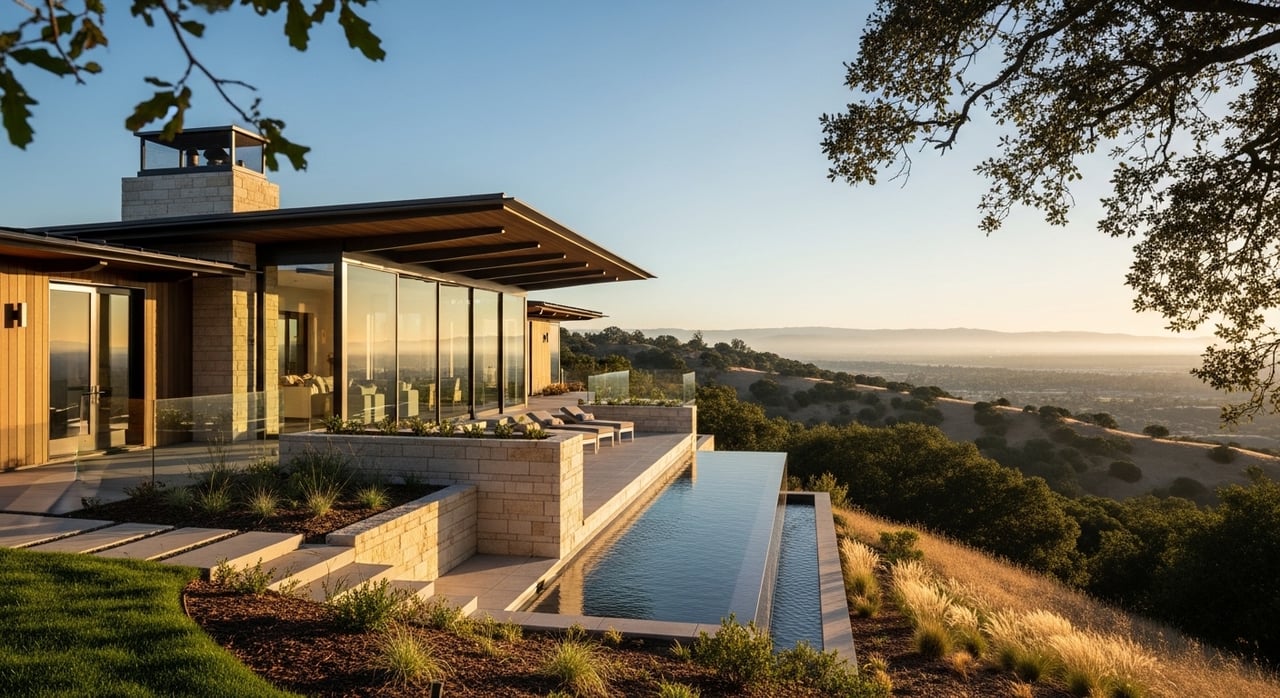
Thinking about building a custom home in Los Altos Hills? The opportunity is exciting, but the process is more complex than many buyers expect. Before you commit to a lot or finalize plans, it helps to understand how the town’s semi-rural planning rules, hillside conditions, and permit process can shape what is actually possible. Let’s dive in.
Los Altos Hills planning comes first
Los Altos Hills is intentionally low-density, and that matters from day one. According to the town’s open space guidance, much of the open space is privately owned and maintained, and the town’s large-lot approach is meant to help preserve that character.
The town’s General Plan land use policies also make the priority clear: the natural environment should dominate the visual character of a lot. In practical terms, that means your home design is expected to respond to the land, not overpower it.
If you are used to flatter suburban parcels, this is an important mindset shift. In Los Altos Hills, the lot itself often drives the design, placement, and scale of a future home.
The lot may limit the house
Not every large parcel offers the same build potential. The zoning code requires a minimum parcel size of 43,560 square feet, and each lot must include a 160-foot diameter building circle. It also requires at least one net acre within a circle no greater than 350 feet in diameter, according to the town’s zoning standards.
That means a parcel can look substantial on paper but still present siting constraints in reality. Shape, slope, and usable area all matter when you are evaluating whether a lot can support the home you have in mind.
The town also uses slope-sensitive standards tied to development area, floor area, net acreage, and something called the lot unit factor. The General Plan notes that lots with a lot unit factor below 1 are nonconforming, and lots at or below 0.5 can require a Conditional Development Permit.
For buyers, this is one of the biggest reasons due diligence matters before you close. A beautiful site does not always translate into a straightforward build.
Hillside features can shrink the envelope
In Los Altos Hills, natural features are not just scenic. They can directly affect where and how you build. The General Plan identifies steep slopes, ravines, drainage swales, and geologic hazard areas as features that should be left undisturbed to the maximum extent feasible.
Open-space easements are another major factor. The town says these areas remain privately owned, but they must stay undeveloped and in natural condition. Easements may be required where there are slopes generally over 30%, heritage oaks, or creek corridors, based on the same General Plan guidance.
This can materially reduce the buildable envelope on a parcel. If you are comparing properties, it is smart to look beyond gross lot size and focus on where development is actually likely to be allowed.
Height and massing are tightly controlled
Even if a lot can support a new residence, the town still places careful limits on height and visual impact. Under the zoning code, the base structure-height limit is 27 feet. A primary dwelling may reach 32 feet only with increased setbacks, and the overall building-height cap remains 35 feet.
The town’s planning framework explains that the 27-foot limit is meant to help homes stay low-profile and consistent with the semi-rural setting. So if you are envisioning a taller or more vertical design, the site and setback requirements become especially important.
Ridgeline and hilltop parcels can bring even more restrictions. The town’s Fast Track guide for new residences says those homes may need to be one story, and it strongly discourages stacked three-story facades and unnecessary grading.
Site design matters as much as house design
In many markets, buyers focus on square footage first. In Los Altos Hills, site planning is just as important. The town’s review priorities favor projects that follow the contours of the land, preserve trees and drainage, minimize grading, and stay within the lot’s slope-sensitive envelope, as reflected in the town’s Fast Track guidance.
That often means the best custom homes here begin with restraint. A plan that respects topography and natural conditions is more aligned with town expectations than one that tries to force a conventional flat-lot layout onto a hillside parcel.
For you, that can affect everything from driveway alignment to outdoor spaces to where the main living areas should sit. The earlier your team studies the site, the better your odds of avoiding costly redesigns later.
The permit path is more than a building permit
One of the most common surprises is that a custom home in Los Altos Hills is not simply a building-permit application. The town requires a site-development permit before a building permit, and most projects that expand floor area or development area also require a zoning permit, according to the town’s site-development review FAQ.
New residences and major additions may also require review by the Town Geologist. If grading, drainage, driveways, roads, or pathways are involved, Planning and Engineering staff may also be part of the process, based on the town’s application and review materials.
Depending on the project, review may be administrative, through Fast Track, or through a Planning Commission public hearing. If a hearing is required, nearby owners are notified, and approvals can be appealed, as described in the same town review materials.
Early meetings can save time
The town recommends beginning with an initial information meeting or a site-analysis meeting. At that stage, staff can review preliminary plans and prepare a checklist of required submittal items, according to the town’s site-development process documents.
That early feedback can be extremely valuable if you are still deciding between parcels or refining design goals. It can help you identify likely issues tied to grading, drainage, setbacks, access, or environmental constraints before you spend heavily on full construction drawings.
The town also recommends sharing plans with neighbors before filing. In some cases, early communication can help resolve concerns during design rather than later in the entitlement process.
Expect a coordinated consultant team
A serious custom-home project here usually requires more than an architect. Based on the town’s application requirements, owners should expect to coordinate professionals such as a civil engineer, geotechnical professional, surveyor, and often a landscape professional in addition to the architect.
That structure reflects the issues the town reviews. Grading, drainage, geotechnical conditions, fire access, open-space easements, pathways, landscaping, and final location certification can all come into play.
The town’s standard conditions for new residences and major additions frequently include a landscape plan, grading and erosion-control plan, fire sprinklers or a hydrant, and certification of height and location by a civil engineer or licensed land surveyor. The Fast Track guide also emphasizes Class A roofs, fire-resistant landscaping within 30 feet of the house, and emergency vehicle access and turnaround.
Timeline expectations should be realistic
If you are trying to line up land acquisition, design, and construction timing, realistic expectations matter. The town says the average time from site-development submittal to building-permit issuance is 13 to 17 weeks, based on its permit timing information.
That does not mean every project moves on the same schedule. The site-development materials also describe a 30-day initial review period, and staff or agency responses to revisions can take 10 to 30 days.
The town also notes that building permits must be submitted electronically through its eTrakit portal. For owners, the key takeaway is simple: entitlement timing should be built into your planning from the start.
Remodel versus rebuild is not always simple
Some owners assume a major renovation will be easier than building new. In Los Altos Hills, that is not always true. The town’s site-development review FAQ states that all exterior modifications, all new structures, and new coverage such as decking, patios, and walkways must be reviewed for compliance.
That means a substantial addition can trigger much of the same scrutiny as a new home, especially on constrained sites with slope, height, setback, grading, or easement issues. If you are weighing whether to remodel or start over, the right answer often depends on the site more than the age of the existing house.
A thoughtful acquisition strategy can make a big difference here. Understanding the town’s process before you buy or before you commit to a renovation budget can help you avoid expensive surprises.
What buyers should evaluate before buying land
If you are considering a teardown, vacant parcel, or older home as a future build site, focus on fundamentals early:
- Buildable area, not just total lot size
- Slope and topography across the likely home site
- Possible open-space easements tied to slopes, oaks, or creek areas
- Height and setback limits that may affect design options
- Driveway, fire-access, and turnaround needs
- Drainage and geotechnical considerations
- Whether the lot may trigger additional permit review
- How much grading the concept would require
In Los Altos Hills, these details can shape value as much as location or views. A parcel that looks ideal online may be far more constrained once the planning framework is applied.
If you are evaluating a purchase, having a local advisor who understands how site conditions connect to resale potential, cost, and timeline can help you make a more informed decision. If you are exploring land, teardown, or custom-home opportunities in Los Altos Hills, the Straser Silicon Valley Team can help you assess property fit, navigate local considerations, and plan your next move with a white-glove, informed approach.
FAQs
What should you know about lot size rules in Los Altos Hills before building a custom home?
- Los Altos Hills requires a minimum parcel size of 43,560 square feet, a 160-foot diameter building circle, and at least one net acre within a circle no greater than 350 feet in diameter, so lot dimensions and usable area matter as much as total size.
What permit process applies to a new custom home in Los Altos Hills?
- A new custom home generally requires a site-development permit before a building permit, and many projects also need a zoning permit, with review potentially involving planning, engineering, geotechnical, fire, water, and other town or agency input.
What height limits apply to custom homes in Los Altos Hills?
- The base structure-height limit is 27 feet, primary dwellings may reach 32 feet with increased setbacks, and the overall building-height cap is 35 feet.
What site conditions can limit where you build on a Los Altos Hills lot?
- Steep slopes, ravines, drainage swales, geologic hazard areas, creek corridors, heritage oaks, and possible open-space easements can all reduce the buildable area on a parcel.
What is the average permitting timeline for a Los Altos Hills custom home?
- The town states that the average time from site-development submittal to building-permit issuance is 13 to 17 weeks, although revisions and project complexity can extend the timeline.
Is remodeling easier than rebuilding in Los Altos Hills?
- Not necessarily, because major additions and other exterior changes may be reviewed under many of the same site constraints that affect new construction, especially on hillside or otherwise constrained lots.