
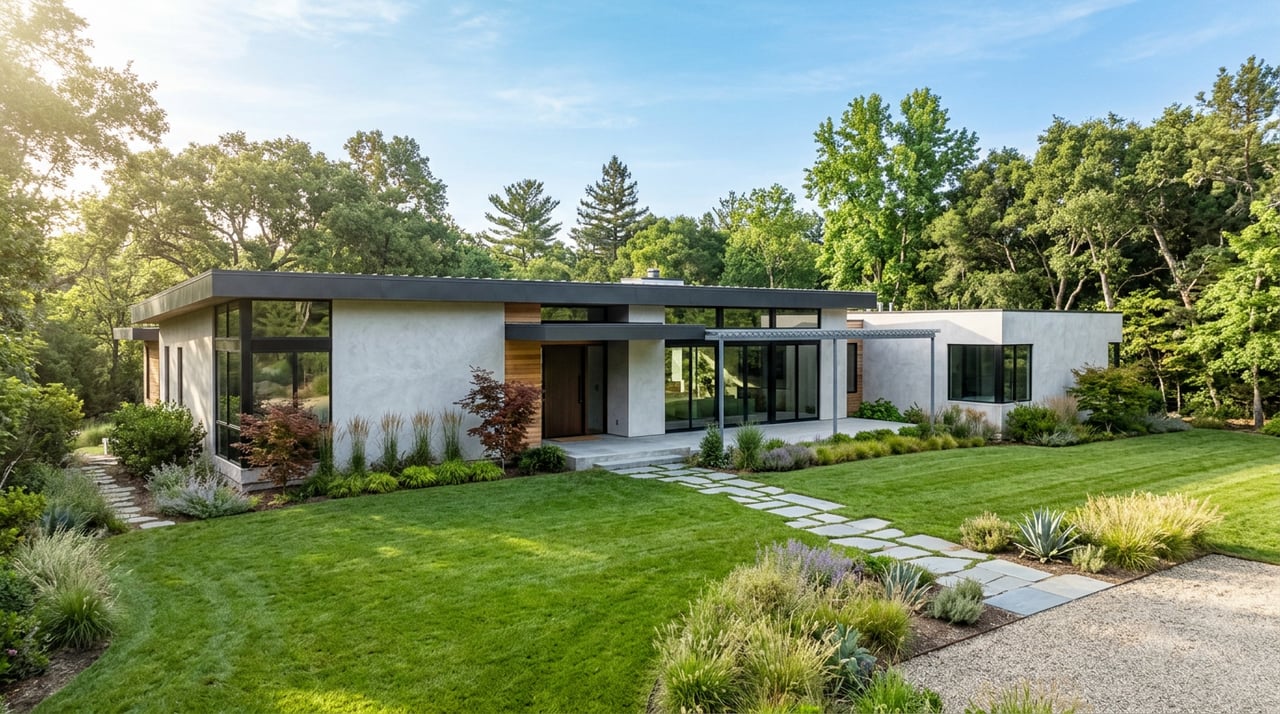
Walk around the west side of the Atherton Library, past the reading room windows and under the line of redwoods and oaks that have stood there longer than the building has, and you land in 6,200 square feet of willow hut, tree house, branch tunnel and climbing boulder. No slide. No swing set. No monkey bars. That absence is not an oversight. It is the entire design brief, and understanding why tells you more about how Atherton actually spends money on itself than any amenity list could.
The Children's Garden had its ribbon-cutting on June 27, with Mayor Stacy Holland and Vice Mayor Rick DeGolia, who also chairs the San Mateo County Libraries Joint Powers Authority governing board, cutting the ribbon in front of families who'd been asking about this space since the old library's garden disappeared during construction of the current building. Storytime and hands-on maker activities filled out the rest of the morning. If you have a library card and a kid under ten, you have probably already found the willow hut. If you don't, here is what's actually there and why it looks the way it does.
A nature space, deliberately, not a playground
When Public Works Director Robert Ovadia brought the design to the Atherton Town Council on February 19, he was explicit about what the town was building and what it wasn't. The plan called for a willow hut, a tree house, a tunnel of branches, boulders, stumps, benches and pathways, all wheelchair accessible, with new ramps cut into the backside of the library to make the whole space reachable regardless of mobility. Ovadia's framing was direct: it's a nature space, filled with natural components, not a playground. No swings. No monkey bars.
Much of what you'll touch there started somewhere else in town. The plan called for reclaimed materials gathered from around Atherton, including salvaged oak logs and stumps, rather than new manufactured play equipment. That choice shows up in the finished product. This isn't a catalog structure dropped onto a lawn. It's built from the same trees residents drive past every day, repurposed into something kids climb on.
The garden sits under a grove of redwood and oak trees on the library's west side, connected to an outdoor classroom that ties directly into the library's makerspace, so a kid can move from 3D printing and laser cutting indoors to a branch tunnel outdoors without leaving the property. That adjacency was intentional. It's the same instinct that shaped the rest of the library building, which also houses a meeting room named for Willie Mays, the longtime Atherton resident and Hall of Fame Giant, inside a Historic Town Hall the library renovation preserved rather than replaced.
Why the money could only go here
Here's the part most visitors to the garden never think to ask about, and it's the reason this project exists at all rather than sitting on a wish list.
Atherton's library is funded through a dedicated library tax, and when DeGolia explained the funding at the February council meeting, he was clear that any surplus from that tax can only be spent on library improvements. It cannot be redirected to street repaving, town hall staffing or the park across town. Once the library building's own renovation was paid off in full, the town had accumulated restricted funds sitting in that library account with nowhere else to go. Community outreach identified the nature garden as the preferred use for that money, and that is the mechanism that put a $475,000 estimated line item in front of the council in February and, by the time construction wrapped, turned into a completed $682,000 project funded through the library Joint Powers Authority plus a $10,000 gift from the Friends of the Atherton Library.
That distinction matters if you were at the February meeting or heard about it secondhand, because several residents pushed back at the time, questioning why the town was funding a new nature space while it was simultaneously renovating the playground at Holbrook-Palmer Park. DeGolia's answer was procedural rather than persuasive on aesthetics: the two projects draw from entirely separate pots of money, and the library funds legally could not have gone toward Holbrook-Palmer's playground regardless of preference. The garden isn't competing with the park upgrade for the same dollars. It couldn't, even if the town wanted it to.
What this means if Holbrook-Palmer has been it for you
Atherton doesn't have a downtown, and outside of the roughly 22-acre Holbrook-Palmer Park with its Main House, Jennings Pavilion and Carriage House rental spaces, the town has had exactly one public gathering space with any regularity to it. That's part of why the library building itself, which reopened in 2022 with the makerspace, the Willie Mays room and the renovated Historic Town Hall, already functioned as something closer to a second town commons than a typical branch library. The Children's Garden extends that role specifically toward families with young kids, giving Atherton a second outdoor public space for the first time in years, one built for a different age group and a different kind of use than Holbrook-Palmer's ball fields and tennis courts.
If your family's outdoor rotation has been Holbrook-Palmer and not much else, this is worth the walk over, especially since parking during library hours is far less contested than it was during the Town Center's grand opening back in 2022, when overflow parking had to be routed to the park itself.
What's actually running there this fall
The garden isn't a static installation. San Mateo County Libraries programs regular storytimes in the Atherton branch's children's room, including Baby Bounce and Musical Jamboree sessions aimed at newborns through toddlers, plus family Maker Exploration sessions in the adjoining makerspace where kids can try 3D printing and laser cutting under supervision. The Friends of the Atherton Library, the same nonprofit that chipped in on the garden's construction, also run the town's recurring Heritage Room author talks and family traditions like the annual Halloween Spooktacular and the Tree Lighting and Cookie Decorating event, both organized jointly with the Atherton Police Department and the Town of Atherton. None of those started because of the garden, but the garden gives the outdoor half of that calendar somewhere new to happen.
The library keeps its normal hours through most of the fall, with brief closures around Indigenous Peoples' Day in October, Veterans Day in November and the Thanksgiving and winter holidays, so if you're planning a visit around a specific storytime slot, it's worth checking the current schedule before you go.
The short version
The willow hut and the tree house are the part you'll notice first. The part worth knowing is that this garden exists in its current form, funded at this level, built from reclaimed Atherton oak rather than off-the-shelf equipment, because of a tax restriction that gave the town no other legal place to put the money. That's not a knock on the result. Miller Company Landscape Architects and Selway Construction delivered something that reads as considered rather than default, and the accessibility work, from the ramps to the wheelchair-friendly pathways, went well beyond what a standard playground retrofit would have required. It's just worth knowing, next time someone in town wonders aloud why Atherton built a nature garden instead of fixing something else, that the honest answer is procedural. The library fund had a surplus. The library fund could only fund the library. The garden is what community input said to build with it.
If you're weighing what a specific Atherton property is actually near, from Holbrook-Palmer to the library's new garden to the rest of the town's short list of public spaces, Straser Silicon Valley can walk you through it with the same level of neighborhood detail. Request a white-glove consultation to talk through what's changing in Atherton this season.